When customers purchase and choose diving suits, they are most concerned about whether the material is environmentally friendly, how durable it is, and how good its warmth retention and elasticity are. The mainstream material for high-quality diving suits on the market is high-elasticity neoprene (NEOPRENE). The inner layer is made of nylon fabric or polyester fabric. It is environmentally friendly, odorless, has strong elasticity, retains warmth and is waterproof, resistant to seawater corrosion. It does not harden or crack even after being soaked in seawater for a long time. It is recognized as a high-quality fabric in the industry. Poor-quality diving suits often use recycled rubber and thin miscellaneous materials. They may not cause problems when worn initially, but after a few dives, they become hard, deformed, lose color, and have a pungent odor. They are also uncomfortable to wear close to the body.
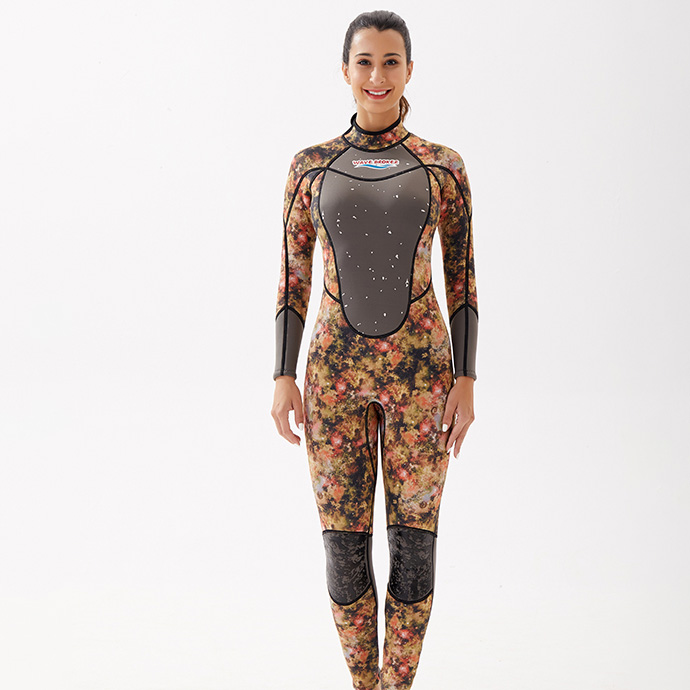
To distinguish the quality of a diving suit, consider the following points: Firstly, feel the elasticity. High-quality models will quickly return to their original shape after being pulled, without sagging. Secondly, observe the stitching lines. Neat double-line edge stitching and seamless interface make it less likely to get waterlogged or fray. Thirdly, smell the odor. Official and environmentally friendly materials have no pungent smell, while inferior ones have a strong odor. Fourthly, check the uniformity of thickness. High-quality materials have uniform thickness, without being thicker on one side and thinner on the other. Our company's all diving suits are made from new and environmentally friendly raw materials, free of formaldehyde and odors. They have sufficient elasticity, are wear-resistant and anti-aging, and are suitable for quality inspection. Whether it's for individual retail or bulk purchase, they can ensure quality and will not deform or peel off when used for long-term underwater operations.

 Ali Mall 1
 Chinese