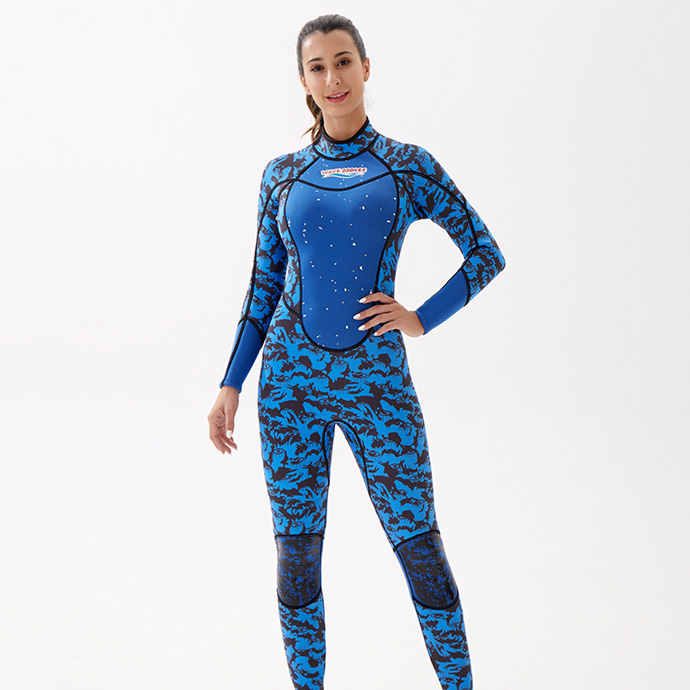
Many customers cannot distinguish between wet and dry diving suits and don't know which one suits them. In fact, the application scenarios of the two are quite different. The wet diving suit is the most common style on the market. Its material is mostly chloroprene NEOPRENE. It has a close-fitting design. A small amount of seawater seeping into the inner layer of the fabric forms a thermal insulation layer, preventing the cold water from circulating. Its advantages are that it is affordable, easy to put on and take off, and has a high degree of freedom for limb movement. It is suitable for snorkeling, surfing, island leisure diving, and beach outings. It is also the most commonly used type by the general public.
The dry diving suit is fully sealed and waterproof. Sealing rubber strips have been installed at the neck, wrists and ankles, effectively preventing seawater from entering. Warm clothing can be added inside. It is suitable for professional scenarios such as low-temperature deep diving, winter ice-water diving, professional underwater engineering, and salvage operations. The disadvantages are that the price is relatively high, the wearing and removing process is troublesome, and professional adjustment is required. It is not necessary for daily leisure activities to purchase this type. For ordinary tourists and water enthusiasts, choosing a wet diving suit is sufficient. For professionals and those engaged in long-term low-temperature underwater operations, the dry model should be considered, as it offers better cost-effectiveness and practicality.

 Ali Mall 1
 Chinese